
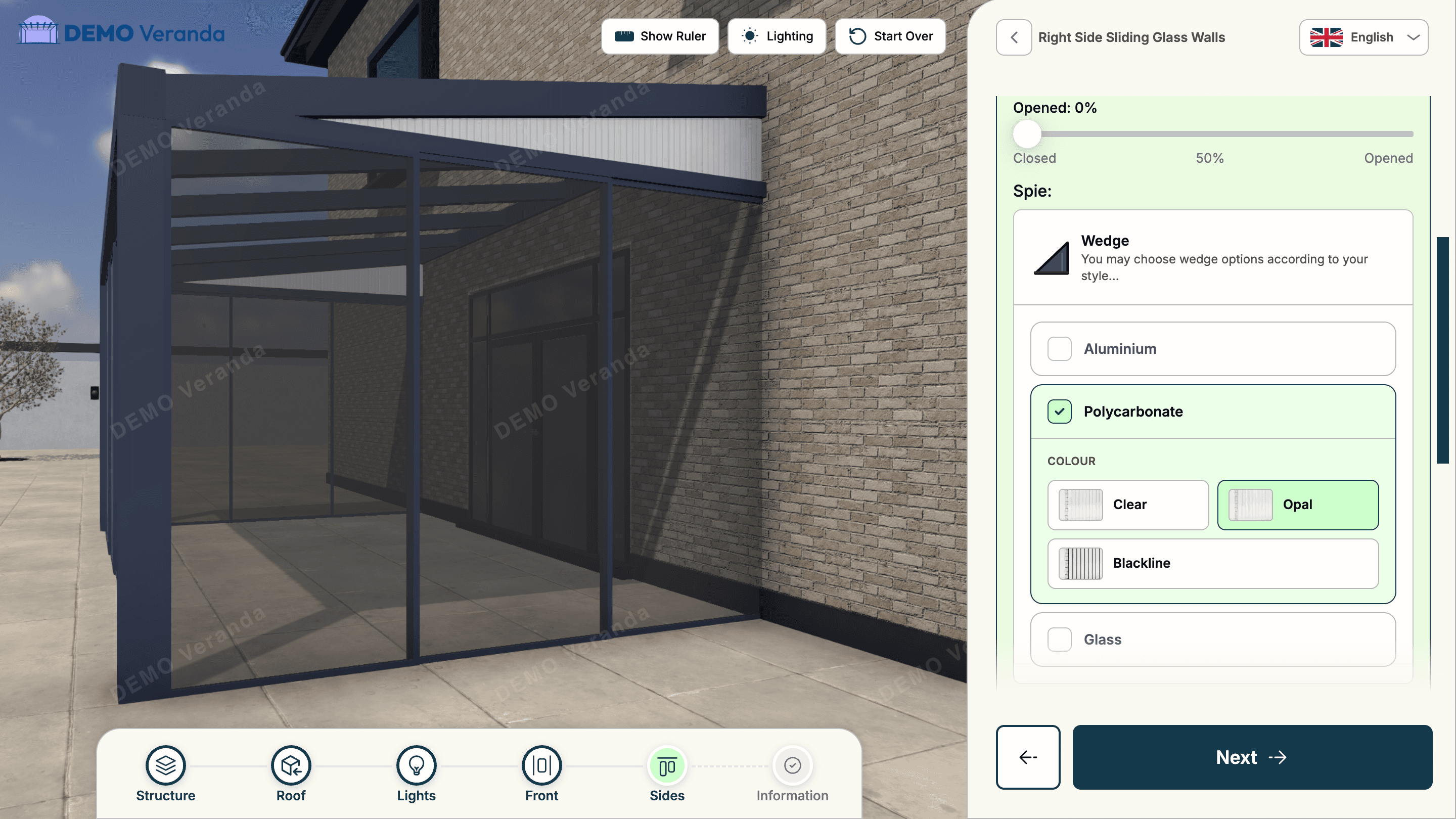
What exactly is a 3D veranda configurator?
A 3D veranda configurator is a web-based sales tool that lets homeowners design a veranda, patio cover or outdoor living structure in real time — choosing dimensions, roofing materials, side walls, colour schemes and optional extras — while seeing a photorealistic 3D model update live with every choice.
Unlike a static product brochure or a PDF price list, a configurator is interactive. The customer is in control: they build their own product, see it rendered in three dimensions, and receive an instant price. When they submit, the dealer receives a complete lead with the exact configuration, contact details and a generated quote — no back-and-forth required.
3D configurators are not new in sectors like automotive (BMW, Tesla) and furniture (IKEA), but they are rapidly becoming standard in outdoor living and veranda dealerships across Europe. The technology has become accessible enough for SME dealers to deploy a branded, fully configured version without a development team.
How it works from the customer's perspective
The customer journey in a 3D configurator typically flows like this:
- Open the link or embedded page. The configurator loads directly in the customer's browser — no app download, no login. It works on a smartphone, tablet or desktop.
- Choose a structure type. The customer selects the style of veranda they want: a free-standing pergola, an attached lean-to, a glass room, or another structure from the dealer's catalogue.
- Set dimensions. Width and depth are entered or slider-adjusted. The 3D model scales in real time. A price counter at the bottom updates instantly.
- Select materials and finishes. Roof type (polycarbonate, glass, aluminium), frame colour, side walls, gutters — every option updates the 3D model and the price simultaneously.
- Add extras. Lighting kits, heaters, sliding glass walls, integrated screens — shown as toggles with add-on prices.
- Submit the configuration. The customer enters their name, email and address. The dealer receives a detailed lead including the full specification and an auto-generated quote PDF.
The entire journey takes 5–10 minutes. According to research by Nielsen Norman Group, product configurators significantly increase time-on-site and purchase intent when the rendering quality is high and the interaction is fluid — both are table stakes for modern 3D veranda configurators.
How it works from the dealer's side
From the dealer's backend, a 3D veranda configurator is a product management and lead generation system. Here is what a dealer controls:
- Product catalogue management. The dealer defines which structures, materials and options appear in the configurator. Products can be shown or hidden, reordered, or restricted by customer type.
- Pricing rules. Base prices, area-based pricing (price per m²), material surcharges and option add-ons are all configurable. The price the customer sees is calculated live using your rules.
- Lead inbox and CRM. Every completed configuration arrives in the dealer's dashboard with full contact information, the configuration JSON, an image render and a price. Leads flow straight into a customer relationship management system.
- Quote generation. A full professional quote PDF can be generated from the configuration with one click — including a 3D render, itemised price breakdown and a digital signature block.
- White-label settings. The configurator URL, branding, colours and domain name are all customisable. Customers never see "Powered by Zinevu" unless the dealer wants them to.
This means the dealer spends less time on the phone collecting measurements and specifications, and more time closing signed quotes.
The business case: why configurators increase sales
The commercial argument for a 3D configurator comes down to three things: more leads, higher close rates and shorter sales cycles.
More and better qualified leads
A configurator on your website converts passive visitors into active leads. Unlike a contact form that asks "tell me what you want", a configurator lets the customer show you. By the time a lead submits, they have already invested 5–10 minutes in designing their product — they are significantly more committed than someone who filled in a name and email address.
Research by Salesforce Research consistently shows that leads who interact with product visualisations before making contact convert at higher rates than those who do not. In the outdoor living sector, where the average purchase value ranges from €5 000 to €25 000+, this difference is material.
Higher close rates
When a customer has designed their own veranda, seen it in 3D and received an instant price, the sales conversation starts from a fundamentally different place. The dealer is no longer selling a product — they are confirming a decision the customer has already made.
Dealers using the Zinevu 3D configurator report close rates on configurator leads that are significantly above their close rates on traditional web leads or phone enquiries. The difference is attribution: the customer has done the qualifying work themselves.
Shorter sales cycles
The traditional veranda sales cycle involves: initial enquiry → site visit → measurement → manual quote → back and forth on spec → revised quote → sign. This process often takes two to four weeks.
With a 3D configurator, much of this happens before the first contact. The dealer already has the configuration, the dimensions and an approved price range. The sales cycle compresses to: configurator submission → personalised follow-up → site visit → sign. For standard structures, this can happen in days rather than weeks.
Key features to look for in configurator software
Not all 3D configurator software is created equal. When evaluating options for your outdoor living dealership, look for these critical capabilities:
- Real-time 3D rendering quality. The model must be photorealistic enough to convince a customer this is what their garden will look like. Low-quality renders reduce trust and purchase intent.
- Mobile-first design. More than half of configurator sessions happen on a smartphone. A configurator that is difficult to use on mobile loses the majority of its potential leads. According to Think with Google, 53% of mobile users abandon a site that takes more than 3 seconds to load — configurators must be optimised accordingly.
- Instant pricing. Customers expect prices to appear in real time as they configure. A configurator that requires a callback for pricing adds friction and loses leads.
- Lead capture and CRM integration. The configuration data must flow directly into your sales workflow. Manual data entry defeats the purpose.
- White-label capability. For professional dealers, serving the configurator from your own domain with your own branding is essential for trust and brand consistency.
- Quote generation. The output of a configuration should produce a professional quote PDF, not just a data export.
- Multi-structure support. If you sell verandas, carports, glass walls and pergolas, you need a configurator that handles all of them — not just one product type.
You can see how Zinevu addresses each of these on the 3D Configurator platform page, or sign up for free to see it running on your own product range.
Who benefits most from a 3D configurator?
A 3D veranda configurator is most valuable for businesses with these characteristics:
- Product variety and customisation. If your products come in multiple sizes, materials and finishes, a configurator replaces hundreds of static price table combinations with a single interactive tool.
- High average order value. The ROI on configurator software scales with average ticket size. At €8 000 per average project, converting even one extra lead per month justifies the investment several times over.
- Online-first sales strategy. Dealers who want to generate qualified leads online — rather than relying entirely on showroom visits — benefit most from having a configurator on their website.
- Lean sales teams. A configurator pre-qualifies and pre-specifies every lead, letting a small sales team handle a significantly higher lead volume without additional headcount.
Dealers across the Netherlands, Belgium, Germany and France are deploying 3D configurators as their primary lead generation tool. Whether you sell standard aluminium verandas or fully bespoke glass constructions, the technology is now accessible, fast to deploy and measurable in its impact.
If you are evaluating 3D configurator software, take a look at the Zinevu pricing page or read about how a 3D configurator increases your close rate in our next article.