
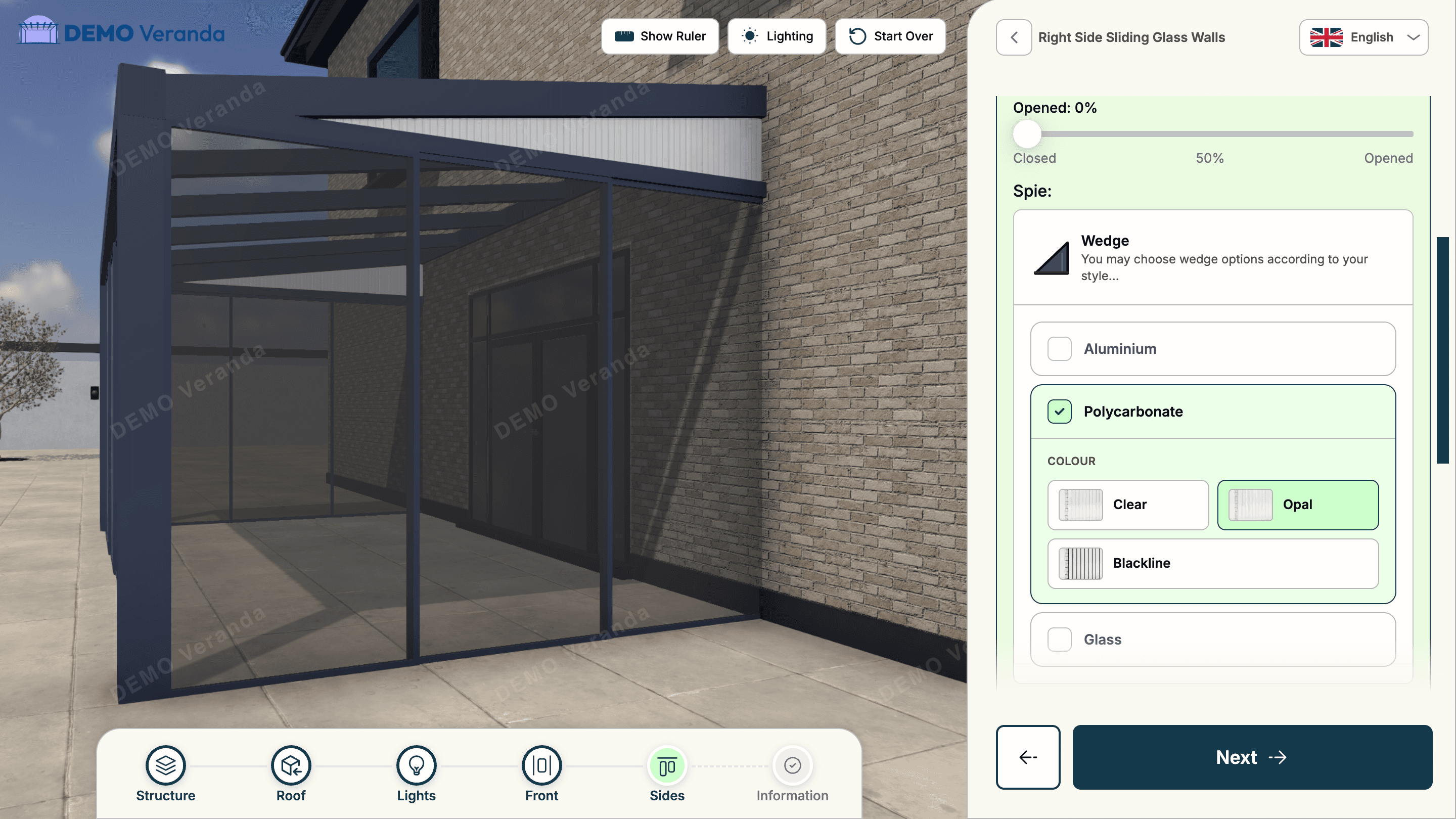
What is a 3D patio cover configurator?
A 3D patio cover configurator is a web-based tool that lets homeowners and dealers design, price and quote a patio cover structure in real time. The customer selects the structure type (aluminium patio cover, pergola with shade sail, louvred roof, attached or freestanding), sets dimensions, chooses materials and accessories, and sees a photorealistic 3D model update live with every selection. When they submit, the dealer receives a qualified lead with the full specification and an auto-generated price.
In the US market, "patio cover" covers a broad range of outdoor structure categories: aluminium insulated patio covers, wood lattice patio covers, clear polycarbonate roofs and pergola kits. A 3D configurator designed for this market needs to handle this variety within a single platform.
This guide explains how 3D patio cover configurators work, why US outdoor living dealers are adopting them at scale, and what to look for in a platform.
The US patio cover market and the shift to digital sales
The US outdoor living market is large and growing, driven by consistent investment in home improvement, the popularity of outdoor entertainment spaces, and a strong replacement market for ageing structures. Patio cover dealers in the US have traditionally relied on in-home consultations and door-to-door sales to generate leads — a model that is expensive per lead and dependent on foot traffic to showrooms.
The shift to digital is accelerating. Homeowners in the US now research patio covers and outdoor structures online before making contact with dealers — searching for design inspiration, product options and price indications. Dealers whose websites can only offer a contact form or phone number miss this research-stage audience entirely.
A 3D patio cover configurator placed on a dealer's website captures this audience at the moment of highest intent. Instead of waiting for the homeowner to call, the dealer lets them design their structure online and submit a complete, specified lead — often before they have contacted any other dealer.
How a 3D patio cover configurator generates qualified leads
The lead generation mechanics of a patio cover configurator differ from a standard contact form in one critical way: the customer self-qualifies.
A homeowner who spends 8 minutes designing a 14ft × 20ft aluminium patio cover with insulated panels, gutter kit and downspouts — and sees a price of $8 400 before submitting — is a fundamentally different lead from someone who fills out a "get a quote" form. They have already:
- Confirmed they want a specific structure type and size
- Seen a realistic 3D visualisation of what it will look like
- Accepted the price range before any human conversation
- Invested 5–10 minutes of personal time in the process
Research by Salesforce Research consistently shows that leads who interact with product visualisation tools before making contact convert at significantly higher rates than cold enquiries. For patio cover dealers with average project values of $5 000–$20 000, this conversion rate difference has a direct and measurable impact on revenue.
What to look for in a 3D patio cover configurator
The US patio cover market has specific product characteristics that the right configurator must handle:
- Multiple structure categories. Your platform must handle freestanding pergolas, attached patio covers, shade sails, insulated aluminium panel systems and louvred roofs — not just one product type.
- Imperial measurement support. US customers think in feet and inches. A configurator that presents dimensions in metric will confuse customers and reduce trust.
- Accessory and add-on support. Ceiling fans, lighting, screens, gutters, downspouts, privacy walls — these are the margin items on a patio cover sale. A configurator that shows them as visual 3D options makes them easy to add.
- Instant pricing. Homeowners doing online research want a price indication immediately. A configurator that requires a callback for pricing loses this audience.
- Mobile optimisation. A significant percentage of research-stage homeowners use smartphones. The configurator must work on mobile devices.
- Lead routing. Leads from the configurator should flow into your CRM or sales system automatically, with enough detail to enable a personalised follow-up call within the hour.
How patio cover configurators shorten the sales cycle
The traditional patio cover sales cycle involves: ad or referral → phone enquiry → in-home consultation → measurement → manual quote → decision time → follow-up → close. The entire process from first contact to signed contract can take 4–8 weeks for a standard installation.
A configurator compresses this significantly. The customer completes the design and specification step themselves. The dealer's first contact is a follow-up on a qualified, priced, specified lead. In-home consultations are shorter (confirming measurements, not starting from scratch) and conversion is higher (price already accepted in principle).
Dealers who integrate a 3D patio cover configurator into their sales process consistently report 30–50% shorter sales cycles on configurator leads compared to cold enquiries — without any loss in job quality or average order value.
Getting started with a 3D patio cover configurator
If you are evaluating 3D configurator software for your patio cover or outdoor living business, the most important first step is to see the tool running on your own product range. Generic demos are less useful than a session where you can see your specific structures, materials and pricing reflected in the software.
Sign up for free with the Zinevu team to see a live configuration on your product types — or read our articles on what a 3D veranda configurator is and how configurators increase close rates for more background.