
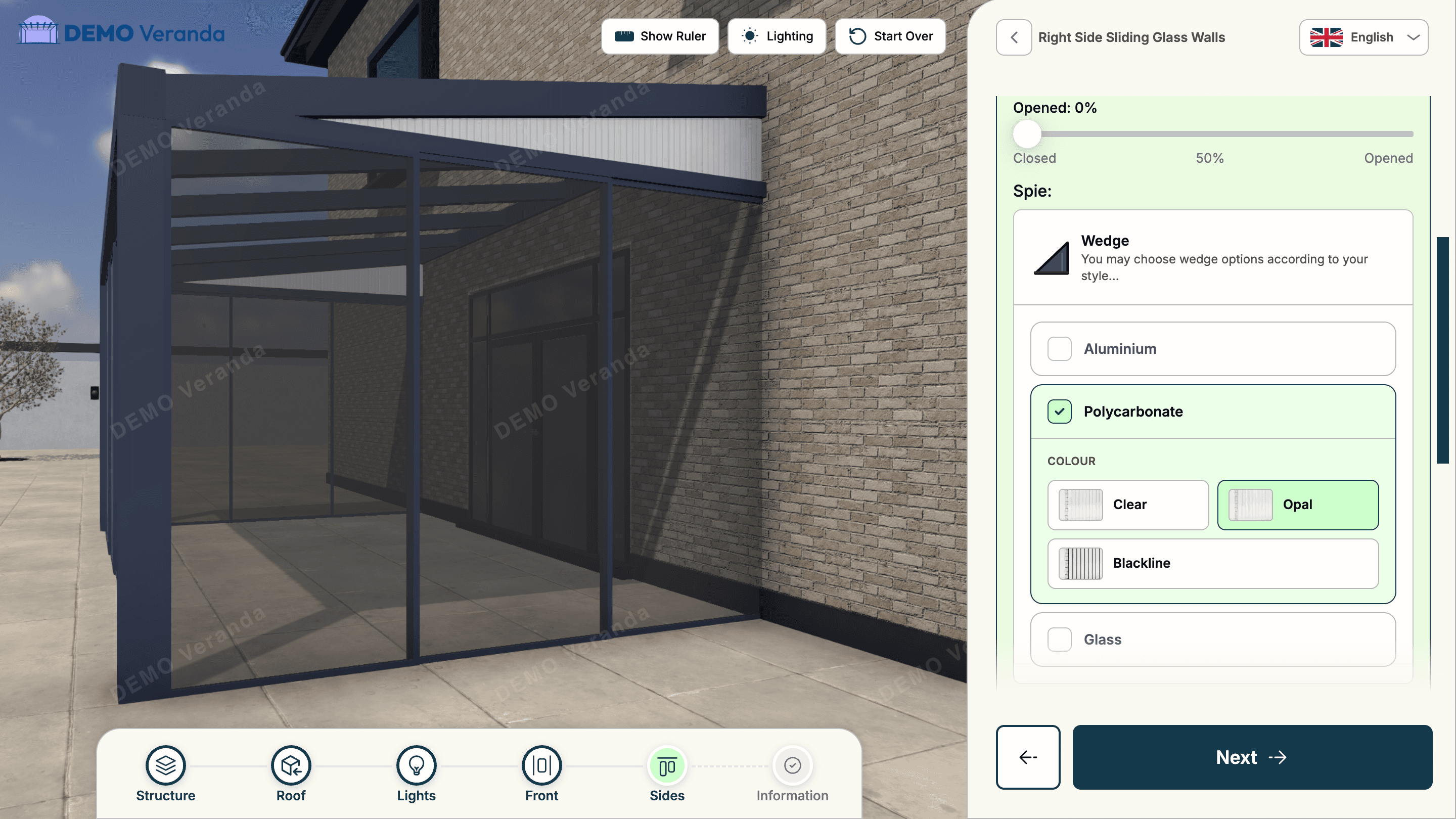
What is pergola design software?
Pergola design software is a digital tool that lets installers, dealers and homeowners visualise, configure and price a pergola before anything is built. Unlike general CAD applications, pergola design software is purpose-built for the outdoor living industry: it understands the specific dimensions, material constraints, structural rules and pricing logic that govern aluminium pergola and bioclimatic pergola products.
The term covers a spectrum of tools — from simple 2D drawing apps used by tradespeople to plan installations, all the way to full 3D configuration platforms that let customers design their own pergola on a dealer's website and receive an instant price. In 2026, the most commercially valuable category is the interactive 3D configurator: a web-based tool that combines product visualisation with CPQ (Configure, Price, Quote) functionality.
This guide focuses on what pergola design software is, why it matters for dealers and installers, and what to look for when choosing a solution for your business.
CAD tools vs. pergola configurators: what's the difference?
The pergola industry has historically relied on general-purpose CAD software — SketchUp, AutoCAD, Revit — for design work. These tools are powerful but expensive to license, slow to learn, and completely disconnected from pricing and sales.
Purpose-built pergola design software solves different problems:
- CAD tools are for professionals who need precise architectural drawings. They require training, are not customer-facing, and produce outputs that most homeowners cannot interpret. A quote made from a CAD drawing still requires manual pricing.
- Pergola configurators are sales tools first. They are designed to be used by customers on your website, by salespeople during showroom visits, or by dealers generating quotes. The output is a photorealistic 3D model, a structured price, and a professional quote PDF — not a technical drawing.
For most outdoor living dealers, the switch from CAD-based design to a configurator-led sales process is one of the most impactful operational changes they can make. Dealers using the Zinevu 3D configurator report that the average time from first contact to signed quote drops from two to four weeks to under a week for standard pergola products.
Who needs pergola design software?
The value of pergola design software depends on what stage of the business you are in:
Installers and small dealers
For a one- or two-person pergola installation business, the main benefit is speed. Generating a professional quote without software takes 30–45 minutes of manual pricing and document work per quote. A configurator reduces this to under 5 minutes. For a business generating 20 quotes per month, that is 8–16 hours of time recovered monthly.
Mid-size dealerships
For dealerships with a showroom and a sales team, pergola design software does two things: it generates leads from the website (customers who design their own pergola and submit a lead) and it standardises the sales process (all salespeople quote from the same rules, eliminating price inconsistency).
Manufacturers and distributors
For manufacturers with dealer networks, the configurator is both a sales tool and a channel enablement tool. Deploying a white-label configurator to each dealer in the network ensures product presentation is consistent, pricing rules are enforced, and lead data flows to the right place. See our article on white-label 3D configurators for more detail.
Key features to look for in pergola design software
When evaluating pergola design software for your business, these are the capabilities that distinguish commercial-grade platforms from basic tools:
- Real-time 3D rendering. The model must update instantly as customers change dimensions, materials and options. Static 3D renders that require a "generate" step break the flow and reduce engagement.
- Bioclimatic and louvred roof support. Bioclimatic pergolas (with adjustable aluminium louvres) are one of the fastest-growing product categories. Your design software must support this product type with its specific configuration logic.
- Structural rules enforcement. Good pergola software prevents impossible configurations — spans that exceed structural limits, unsupported roof sections, incompatible material combinations — without requiring the customer to know the engineering rules.
- Automated pricing. Prices should calculate in real time from your pricing rules — base price by structure type, area-based roof pricing, material and option surcharges. No manual price lookup required.
- Quote PDF generation. The output should be a professional document with your branding, the 3D render, the full price breakdown and a digital signature block.
- Lead capture and CRM integration. Customer configurations must flow directly into your sales system — not into a spreadsheet or email inbox.
- Mobile performance. Over half of web-based configurator sessions happen on smartphones. Pergola design software that is difficult to use on mobile loses the majority of its potential online leads.
The ROI of switching from CAD to a pergola configurator
The business case for purpose-built pergola design software is straightforward:
- Faster quotes. From 30–45 minutes to under 5 minutes per quote. For a dealer producing 40 quotes per month, that is 16–26 hours of time recovered.
- Online lead generation. A configurator on your website converts visitors who would otherwise leave without contacting you. Visitor-to-lead rates on configurator pages typically run 3–8x higher than standard contact form pages.
- Higher close rates. Leads who have configured their own pergola are significantly more committed than cold enquiries. They already know what they want and what it costs. According to Gartner's CPQ research, guided selling tools improve win rates by 10–30%.
- Fewer errors. Automated pricing eliminates the manual calculation errors that cost dealers money through underpriced jobs or customer disputes.
If you are currently using CAD software or spreadsheets for pergola quoting, the Zinevu pricing page shows what a move to a purpose-built platform costs — and the sign up will show you the time difference in practice.
How to choose the right pergola design software
The right software depends on your specific business. Here is a practical framework:
- Start with your product range. Does the software support all the structure types you sell? Freestanding pergolas, wall-mounted, bioclimatic, glass roof? A platform that handles your specific product catalogue is worth more than a generic tool.
- Check the customer experience. Can a homeowner with no technical knowledge complete a configuration in 10 minutes on their phone? If not, it will not generate leads from your website.
- Evaluate the quote output. Open the generated quote PDF. Would you be comfortable sending it to a customer? Is it branded, clear and professional?
- Assess integration. Where do leads go? Does it connect to your CRM, your planning tool, your invoicing system? Disconnected tools create manual work.
- Review setup time. Good pergola configurator software should be live within one to two business days. Platforms that require months of implementation are priced and scoped for enterprise, not for dealers.
Read our guide on what a 3D veranda configurator is for a deeper look at how these tools work in practice, or sign up for free to see Zinevu running on your own product range.